
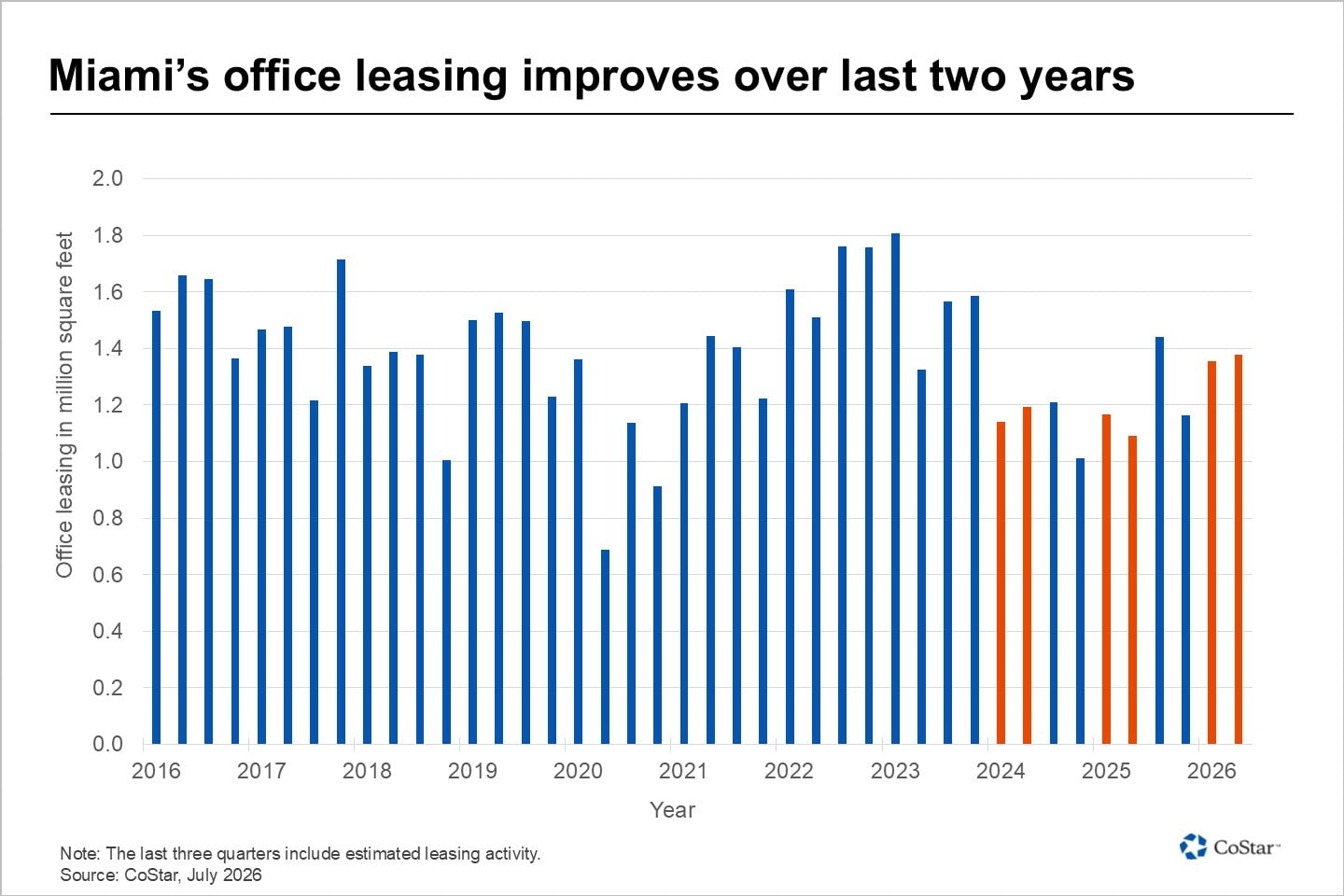

Leasing activity in Miami increased through the first half of 2026, supported by resilient tenant demand and a continued preference for high-quality office space.
In the first half of 2026, 2.7 million square feet of space was leased, compared to 2.3 million square feet in both 2024 and 2025. By comparison, over the 10-year period, in the first half of the year, typically 2.7 million square feet has been leased, so 2026 is back to normal.
The increase in leasing activity has led to an increase in office absorption, the amount of space occupied minus the amount vacated. According to CoStar data, the Miami office market recorded about 445,000 square feet of net absorption over the past 12 months, a rebound from the roughly 150,000 square feet lost in 2025. Even with that improvement, demand remains concentrated in newer and recently renovated buildings, reflecting a broader shift toward top-tier properties.
That dynamic has helped keep vacancy relatively low. Miami’s overall vacancy rate stood at 8.3% as of the third quarter, well below the national average and roughly in line with the market’s long-term norm.
Leasing activity continues to be driven by deals in well-located, amenitized properties. Over the past year, tenants such as law firm Stearns Weaver Miller leased nearly 98,000 square feet at Museum Tower downtown. Other notable transactions include Iru’s 55,400-square-foot lease at Mayfair in the Grove and the University of Miami Health System’s 42,000-square-foot lease at Flagler Station, underscoring steady demand from professional services, technology and healthcare users.
Much of the recent absorption has occurred in higher-quality buildings. Four- and five-star properties accounted for about 260,000 square feet of net absorption over the past year, while lower-tier spaces saw more limited gains or declines. Despite that demand, vacancy in top-tier assets remains elevated relative to other segments, in part due to new supply and a higher concentration of available sublease space.
The divergence reflects a market increasingly defined by tenant selectivity. Companies continue to prioritize modern, amenitized space, even as they reassess overall office needs.
At the same time, a limited supply of large blocks of premium space is constraining options for some tenants. Only a handful of spaces exceeding 50,000 square feet are currently available in top-tier buildings, even as construction activity remains elevated with nearly 3.9 million square feet underway. Major projects such as Santander Tower, which broke ground earlier this year, are expected to add significant new inventory in the coming years.
For now, however, the market remains relatively balanced. Strong demand for high-quality space, combined with constrained availability, has supported continued rent growth, with asking rents rising 4.4% year over year to about $57 per square foot.
While slower office-using job growth and rising sublease availability could weigh on leasing in the near term, Miami stands out as one of the few large office markets where fundamentals remain comparatively healthy. Vacancy is expected to stay low relative to national levels, even as tenants continue to favor quality over quantity in their space decisions.